
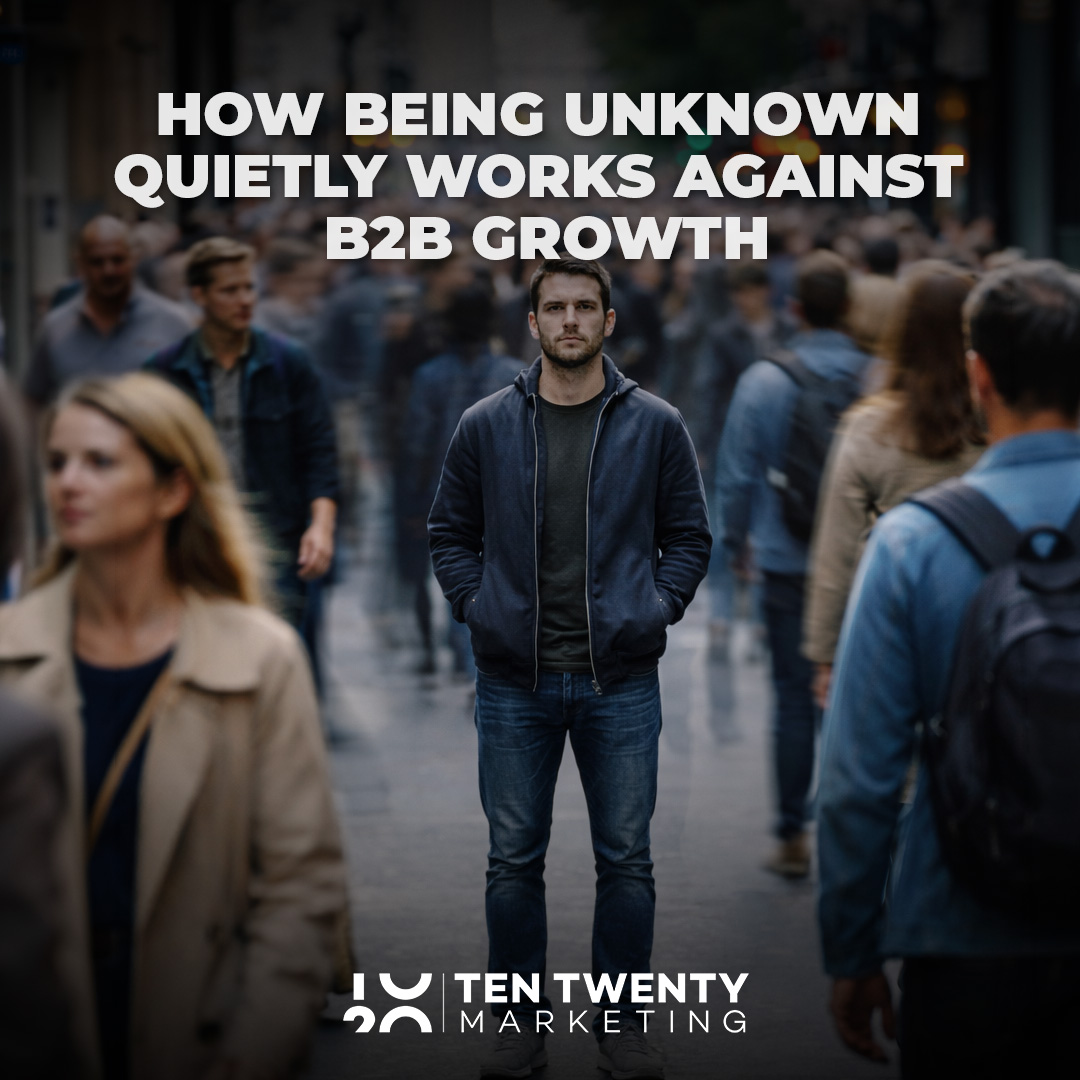
How being unknown quietly works against B2B growth
There is a moment in many B2B sales conversations that determines the tone of everything that follows. It often happens before a word is spoken, when the buyer looks at the company name on a calendar invite or in an email signature and thinks, even briefly, “I don’t recognize this.”
That moment rarely leads to an immediate rejection. More often, it introduces hesitation.
When your best prospects have never heard of you, the challenge is not that they doubt your capabilities. It is that they have no context. And in B2B environments where decisions carry real risk, a lack of context is enough to slow everything down.
The extra work being unknown creates
When a brand is unfamiliar, sales conversations start differently. Buyers listen cautiously. Questions lean toward validation rather than application. More time is spent explaining who the company is and why it exists before the solution is even discussed.
None of this is irrational. In B2B, choosing a partner is not a casual decision. It can affect operations, budgets, and internal credibility. Buyers are rewarded for avoiding mistakes, not for taking chances.
When a company is unknown, buyers instinctively manage risk by asking for more proof, involving more stakeholders, and delaying commitment. The process becomes heavier for everyone involved.
How hesitation shows up in the pipeline
The impact of low awareness rarely appears as outright rejection. Instead, it shows up in softer, harder-to-diagnose ways.
Follow-ups take longer. Meetings are pushed. Decisions are postponed with language that sounds reasonable but vague. “Not a priority right now.” “We need to revisit this later.” “We like what we’re seeing, but we’re not ready.”
These responses are often interpreted as a lack of interest. In reality, they are signals of uncertainty.
Buyers are still deciding whether your company belongs in the conversation.
Why sales cannot solve this alone
Sales teams feel this friction acutely. They work harder to earn trust. They repeat foundational explanations. They provide additional materials and references to compensate for the lack of familiarity.
Even the strongest sales talent cannot fully overcome the disadvantage of being unknown. Sales is designed to advance decisions, not create baseline recognition.
When awareness is missing, sales is forced into a role it was not built for.
The quiet power of familiarity
Familiarity does not guarantee a win, but it changes the rules of engagement.
When buyers recognize a company name, even loosely, conversations feel safer. They listen differently. They ask more relevant questions. They are more willing to explore possibilities.
Familiarity reduces cognitive effort. Buyers do not have to spend as much energy deciding whether the company is legitimate. They can focus on whether the solution is right.
This shift is subtle, but it has an outsized impact on sales efficiency.
Why awareness is often underestimated
Many B2B organizations accept low awareness as the cost of operating in a niche market. The assumption is that because the audience is small, awareness is less important.
In reality, awareness is more important in niche markets. When the pool of buyers is limited, every interaction matters more. Being unknown increases the cost of every sales effort.
Awareness does not require mass reach. It requires consistency in the right places.
How awareness changes the sales experience
When awareness is in place, sales conversations start further down the path. Buyers reference content they have seen. They mention familiarity with the company. They treat the interaction as a continuation rather than an interruption.
Sales teams notice the difference quickly. Meetings feel more productive. Momentum builds faster. Fewer conversations stall in the early stages.
This is not because buyers are rushing. It is because trust has already begun forming.
Preparing the market before the conversation
The role of marketing is to prepare the market so sales do not have to start from zero. Clear positioning, consistent messaging, and repeated exposure give buyers a framework for understanding who you are.
This preparation does not need to be loud or broad. It needs to be deliberate.
When buyers have encountered your company before the first call, sales stop pushing uphill. The conversation becomes about fit, not familiarity.
Recognition before persuasion
B2B buyers rarely engage deeply with something they do not recognize. Recognition precedes interest, and interest precedes action.
When your best prospects have never heard of you, growth slows quietly. When recognition is built, momentum follows.
Awareness is not a vanity metric. It is a prerequisite for efficient sales.